
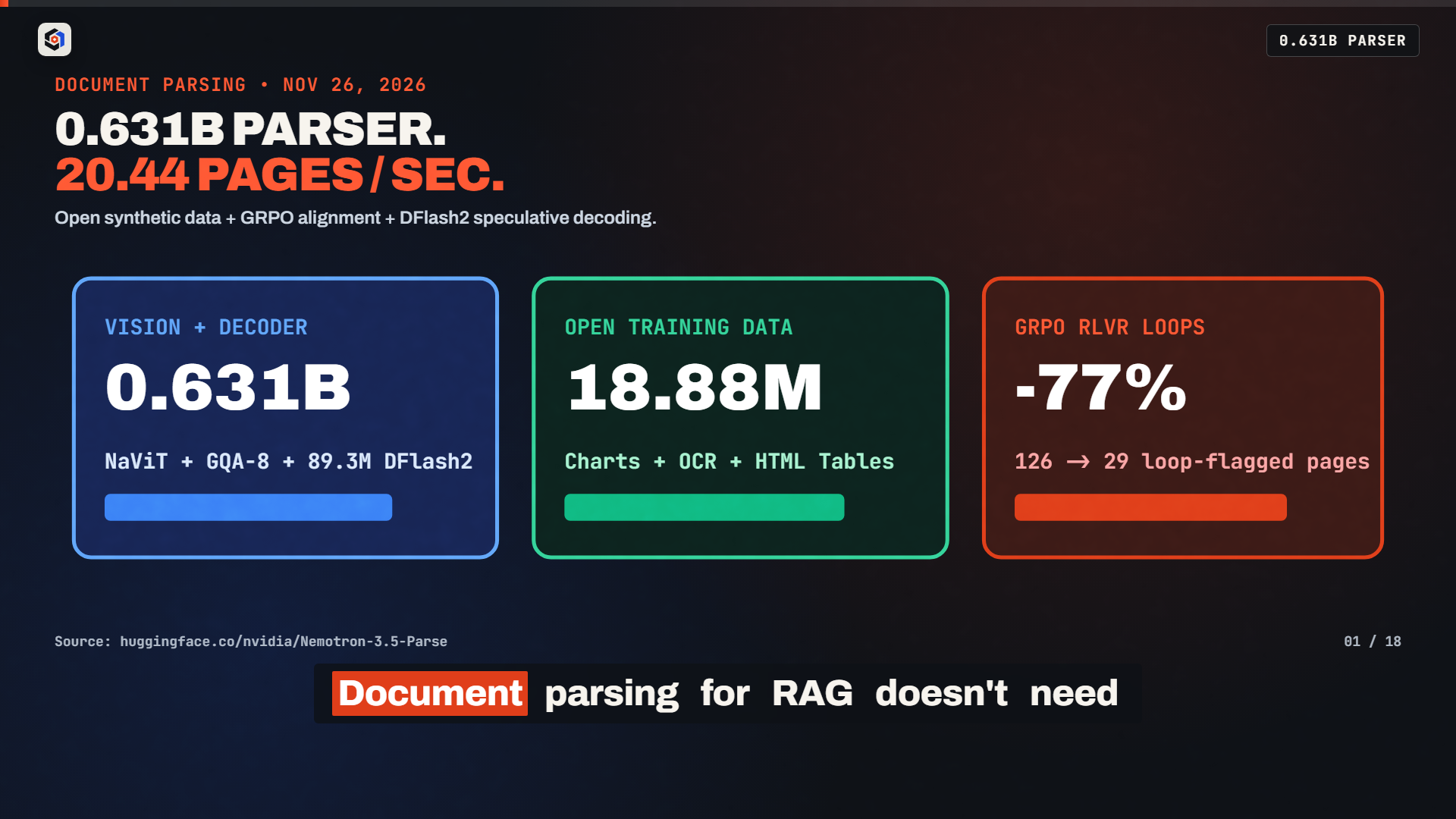
On November 26, 2026, NVIDIA expanded its compact 0.631B Nemotron 3.5 Parse document model with 18.88 million open synthetic chart, table, and multilingual OCR examples, a verifiable GRPO reinforcement learning recipe that cuts infinite loops by 77%, and an 89.3M DFlash2 speculative decoder delivering 7.62x faster single-stream throughput (20.44 pages/s batched) on one H200 GPU.
Document ingestion is often the quiet bottleneck inside retrieval-augmented generation (RAG) pipelines and enterprise agents. Teams either wire expensive general-purpose frontier vision-language models (VLMs) to parse every PDF page, or rely on brittle OCR heuristics that scramble multi-column reading order, drop table headers, and ignore unlabeled chart geometry.
On November 26, 2026, NVIDIA published Building on Nemotron 3.5 Parse, expanding its compact 0.631B-parameter Nemotron 3.5 Parse ecosystem with three open synthetic training datasets totaling 18.88 million examples, a verifiable-reward reinforcement learning (RLVR) post-training recipe in NeMo, and an 89.3M-parameter DFlash2 speculative decoder for vLLM.
Why Does Nemotron 3.5 Parse Beat Frontier VLMs on Ingestion Cost?
Unlike chat-first multimodal models that spend billions of parameters on open-ended reasoning, Nemotron 3.5 Parse is purpose-built for a single job: turning rendered document pages (PDFs, scans, slides, forms, and reports) into reading-ordered Markdown, HTML tables, bounding boxes, and semantic block classes (headings, paragraphs, tables, charts).
NVIDIA also redesigned the architecture between Parse 2.0 and Parse 3.5 to cut memory overhead and decode latency per page:
| Component | Nemotron Parse 2.0 | Nemotron 3.5 Parse (0.631B) | Why It Matters for Pipelines |
|---|---|---|---|
| Page preprocessing | Fixed 2048 x 1664 canvas | NaViT dynamic rectangular inputs | Adapts resolution shape to each page instead of padding fixed frames |
| Image-to-text link | Encoder-decoder cross-attention | Compressed visual tokens as causal prefix | Feeds unified prefix directly into causal text decoder |
| Decoder attention | Multi-head attention | GQA-8 (16 query, 8 key/value heads) | Shrinks KV-cache footprint at higher concurrency |
| Speculative decoding | Built-in 1-token MTP head | 1-token MTP + optional 89.3M DFlash2 drafter | Proposes up to 32 tokens ahead (~14 accepted per step) |
With an open OpenMDW model license and evaluation spanning 163 language and script entries across 26 script groups plus 10 Indic languages, a single GPU node can process structured PDFs locally without per-page commercial API bills.
What Synthetic Datasets Did NVIDIA Open-Source Behind Parse 3.5?
Parsing real charts and nested financial tables fails when models only train on clean digital text. A single shifted cell breaks an HTML table, and real operational reports routinely omit bar-value numbers above chart columns.
To solve both failure modes, NVIDIA open-sourced three paired training corpora alongside Parse 3.5:
- Synthetic Charts V1 (9.98M examples): Rendered plots paired with structured ground-truth specifications so the parser learns to infer numeric values directly from axis scales and bar heights—even when numbers are not printed on the bars.
- OCR Synthetic Multilingual v2 (7.9M examples): Synthetic document pages with Parse-format bounding boxes, semantic tags, and varied fonts across multilingual scripts.
- Synthetic Tables V1 (1M examples): Rendered HTML tables preserving strict row spans, column spans, headers, and cell relationships.
Together, those 18.88 million examples include the rendered page images, target schemas, and generation notes so engineering teams can adapt document parsers for custom domains or underserved languages.
How Much Does RLVR (GRPO) Reduce Loops and Extraction Errors?
Document parsers fail in a distinctive way on dense pages: autoregressive loops. Once a small model repeats a table cell or formatting token, it burns tokens until hitting the generation cap (8,744–9,000 tokens), returning truncated garbage for the entire page.
To fix that, NVIDIA followed Supervised Fine-Tuning (SFT) with Reinforcement Learning with Verifiable Rewards (RLVR) using Group Relative Policy Optimization (GRPO). Rather than forcing one brittle reference token string, verifiable rewards score sampled page extractions for recovered chart series, valid table structure, and clean completion without repetition.
In NVIDIA's published controlled comparison on 2,078 ParseBench pages (measured across matched development checkpoints), GRPO delivered measurable reliability gains over SFT alone:
| ParseBench Evaluation Metric (2,078 Pages) | After SFT | After GRPO (RLVR) | Change |
|---|---|---|---|
| Overall Score (0-100 scale) | 66.24 | 71.38 | +5.14 pts |
| Tables Score | 75.04 | 80.22 | +5.18 pts |
| Charts Score | 47.86 | 52.01 | +4.15 pts |
| Visual Grounding | 62.50 | 69.78 | +7.28 pts |
| Loop-Flagged Pages | 126 / 2,078 | 29 / 2,078 | -77.0% fewer loops |
| Pages Hitting 9,000-Token Cap | 185 / 2,078 | 35 / 2,078 | -81.1% fewer truncations |
How Fast Is DFlash2 Speculative Decoding on One H200 GPU?
Even a 0.631B model has to emit hundreds or thousands of Markdown and HTML tokens per dense page. Standard autoregressive decoding stalls when requests run at low concurrency.
NVIDIA addressed that latency bottleneck with an optional 89.3M-parameter DFlash2 draft model (nvidia/Nemotron-3.5-Parse/tree/main/dflash2). Running natively inside vLLM with --speculative-config '{"method":"dflash","model":"./parse35/dflash2","num_speculative_tokens":32}', the drafter proposes up to 32 tokens ahead, averaging roughly 14 accepted draft tokens (~15 output tokens per verification pass).
According to NVIDIA's native single-pass benchmark on one H200 (BF16, 2,078 ParseBench pages):
- Concurrency 1 (latency-bound single stream): Throughput jumps 7.62x, rising from 0.5385 pages/s (base Parse 3.5) to 4.1042 pages/s with DFlash2.
- Concurrency 512 (high-volume batch ingestion): Parse 3.5 hits 13.4802 pages/s without speculation and 20.4409 pages/s with DFlash2 (1.52x faster than base Parse 3.5, and 6.86x faster than Parse 2.0's 2.9787 pages/s).
When Should Builders Choose Single, Double, or Triple-Pass Parsing?
Fast base inference gives RAG pipelines headroom to spend extra compute selectively on dense pages rather than running heavy passes everywhere:
- Single pass: Parses the full page once into text, layout classes, tables, and charts. Use this as the default for standard multi-column PDFs and web captures.
- Double pass (+2.18 ParseBench points): Crops detected table and chart bounding boxes from pass one and re-parses those zoomed regions at higher detail before merging refinements back into the page tree.
- Triple pass (+2.46 ParseBench points, reaching 75.20 overall on the released model card): Runs a second detection pass first to verify no boxes or small text blocks were missed, then re-extracts detected tables and charts in a third pass.
Because crop refinement issues extra model calls for each detected chart or table, single pass maximizes throughput while double or triple pass handles financial filings, dense forms, and scientific figures where a single missed digit breaks downstream answers.
How Can Teams Deploy and Fine-Tune Parse 3.5 Today?
For local or cluster serving via vLLM with DFlash2 speculation enabled, the Nemotron 3.5 Parse model card documents the two-command setup:
hf download nvidia/Nemotron-3.5-Parse --local-dir ./parse35

vllm serve ./parse35 \
  --served-model-name nemotron-parse \
  --trust-remote-code \
  --speculative-config '{"method":"dflash","model":"./parse35/dflash2","num_speculative_tokens":32}'
For domain-specific forms that break general OCR models, NVIDIA also released a worked NeMo Automodel SFT + NeMo RL GRPO workflow. On a synthetic dental odontogram chart task (requiring exact tooth numbers, planned procedures, affected surfaces, zero text character error, and clean EOS termination), sampled pass@1 climbed to 95.85% after SFT and 96.58% after RLVR across 256 held-out pages.
What Should Engineering Teams Do Next?
- Benchmark single-pass DFlash2 before paying frontier VLM token rates: Spin up
nvidia/Nemotron-3.5-Parsewithdflash2on a single GPU for PDF/Markdown ingestion, reserving large reasoning VLMs for ambiguous follow-up synthesis rather than raw page OCR. - Route dense tables and unlabeled bar charts to double pass: Trigger crop-and-reparse only on pages where pass one detects
tableorchartbounding boxes, capturing most of the+2.18ParseBench accuracy gain without tripling cluster load. - Pair domain SFT with verifiable RLVR rewards: If your pipeline parses specialized schemas (medical charts, customs manifests, CAD schedules), start from NVIDIA's NeMo Parse workflow and write deterministic format/completeness reward functions to stamp out infinite generation loops.
Key Facts
- On November 26, 2026, NVIDIA open-sourced three synthetic datasets totaling 18.88M examples behind Nemotron 3.5 Parse: Synthetic-Charts-V1 (9.98M examples teaching axis/bar value inference), OCR-Synthetic-Multilingual-v2 (7.9M examples across varied fonts and scripts), and Synthetic-Tables-V1 (1M HTML tables). (Source)
- Adding GRPO reinforcement learning with verifiable rewards (RLVR) after SFT on 2,078 ParseBench pages cut loop-flagged outputs by 77% (126 to 29 pages), reduced 9,000-token cap hits from 185 to 35 pages, and lifted overall score from 66.24 to 71.38 (+5.18 on tables, +4.15 on charts). (Source)
- NVIDIA's compact 0.631B Nemotron 3.5 Parse pairs NaViT dynamic inputs and GQA-8 causal decoding with an 89.3M-parameter DFlash2 speculator (proposing up to 32 tokens, averaging ~14 accepted draft tokens per step) to hit 7.62x faster single-request throughput (0.54 to 4.10 pages/s) and 20.44 pages/s at concurrency 512 on one H200 in BF16. (Source)
- NVIDIA's published NeMo Automodel SFT + NeMo RL GRPO workflow shows single, double (+2.18 ParseBench pts), and triple-pass (+2.46 pts, reaching 75.20 overall) crop-refinement strategies, plus a worked synthetic dental odontogram adaptation reaching 95.85% pass@1 (SFT) and 96.58% pass@1 (RLVR) on 256 held-out pages. (Source)
Frequently Asked Questions
How big is Nemotron 3.5 Parse and how fast does it run with DFlash2?
Nemotron 3.5 Parse is a 0.631B-parameter document parser paired with an optional 89.3M-parameter DFlash2 speculative decoder. On one H200 GPU in BF16 across 2,078 ParseBench pages, DFlash2 raises concurrency-1 throughput 7.62x (0.54 to 4.10 pages/s) and reaches 20.44 pages/s at concurrency 512.
What synthetic datasets did NVIDIA open-source on November 26, 2026?
NVIDIA open-sourced 18.88 million paired training examples across Synthetic-Charts-V1 (9.98M chart plots teaching axis/bar value inference), OCR-Synthetic-Multilingual-v2 (7.9M multilingual pages), and Synthetic-Tables-V1 (1M HTML tables).
How does RLVR (GRPO) improve document parsing over supervised fine-tuning alone?
In NVIDIA's controlled 2,078-page ParseBench comparison, GRPO post-training reduced repetition loop-flagged outputs by 77% (126 to 29 pages), cut 9,000-token cap truncations from 185 to 35 pages, and lifted overall extraction accuracy from 66.24 to 71.38.
When should teams use double-pass or triple-pass parsing instead of single-pass?
Single-pass handles standard PDFs at peak throughput. Double-pass (+2.18 ParseBench points) crops detected tables and charts for higher-detail re-extraction, while triple-pass (+2.46 points, reaching 75.20 overall on the model card) adds a dedicated detection pass for dense financial or medical forms.


